
You have probably heard by now that Autodesk has announced that they are  entering the PLM market with the announcement of Autodesk 360 Nexus. I had the opportunity to hear about this in a “behind the scenes” look a while back and attended Autodesk University this week to take in the launch. Autodesk put a lot of emphasis behind the announcement, with CEO Carl Bass bringing up his famous anti-PLM rap where he said the only companies with a PLM problem were Dassault (Sytemes), PTC, and UGS (now Siemens PLM). His message now is that “we did not want to do PLM until we could do it right” and that the time has come. So welcome to the PLM community Autodesk!
What’s the Big Deal? Who Cares?
Autodesk promised that “everything would change” in PLM when the announcement was made. You can read Evan Yares’ view on what has (or hasn’t) changed. I believe that Autodesk meant that everything changes because they offer PLM in the Cloud. It is a software as a service (SaaS) and will offer a different way to buy PLM. The other reason they say things will change is that, as Steve Bodnar says, the solution is “insanely configurable” so manufacturers will not need to change their existing business processes. Those are both very interesting and potential game changers. For more of my thoughts on those, see the questions section below.
Whether you believe that cloud and configurability will really change PLM, one fact it clear. Autodesk has one of the biggest engineering user bases on the planet, and this will change the PLM market. They are serious about PLM. Having another player with the size, user base, and ability to deliver that Autodesk has will have an impact on the market. Will it take away business from competitors? I am not sure how much of that will happen in the near term. But will it get more Autodesk customers started down the path with PLM (with a lower risk model and a vendor they already know)? You bet. Will there be responses by other vendors? Of course, and the response will be based on what kind of traction Nexus gets.
So What will they Offer?
First, the solution is not available yet. You can learn more from Autodesk’s official PLM press release. Second, I will tell you that the solution looks really good based on some limited views. The interface is clean and modern, there are some benefits from starting a design from the ground up for use on the cloud (and on different devices over time). Third, for some more details I don’t want to recreate what others have already posted, so for a nice overview (with screenshots and all!) take a look at Al Dean’s take on D3D. Note that viewing the AC/DC video at the end is entirely optional. 😉
 So with that backdrop, let me share my thoughts on Autodesk’s PLM entrance. They are taking a different approach. They believe PLM has been too difficult and too expensive (see Steve Bodnar’s PLM Non-Starter Picture) and believe that a cloud offering is the answer. Applications designed and built for the cloud are very different, although there are others (including their largest competitors) that are also figuring cloud out. Autodesk sees themselves more like Salesforce.com competing with PLM vendors that are more like Siebel.
Autodesk also believes that changing business processes is a big challenge for companies, and develop Nexus to be highly configurable. I believe this is a double-edged sword. On one hand a company that has well-defined processes can simply model their existing processes in Nexus’ workflow. That sounds great to me. The problem with a lot of companies is that they either don’t have processes, they have poor ones, or they have lots of them. The difficulty in standardizing on a process is an organizational change issue, not a software issue. In fact, from my experience too much flexibility can lead to some really hairy problems for vendors and customers alike. I am not going to get too far up on my soap box right now, but there is a lot more to be said here and I have some learning to do first. I have some follow up planned with Autodesk to understand how much Nexus is application and how much is infrastructure on which you can build a process. For now, let’s just say that Excel and SharePoint are highly configurable too – and what most companies end up with is a lot of non-integrated islands of information and process that don’t fit well together. Flexibility works well for those with very small companies or good information architects to oversee design. Wait, I thought I said I wasn’t getting up on my soapbox? OK, stepping off it now. I even delete another paragraph I wrote while I was up there. 😉
Some Open Questions
The bottom line is that we all have a lot to learn about what Autodesk really delivering and how it will perform. The announcement will clearly have an impact, but also raises some interesting questions:
- Autodesk
 has a lot of architect and construction customers. The “AEC” industry (E for Engineering) is evolving to BIM (Building Information Modeling) – what are the positives and negatives of sharing ideas and capabilities between PLM and BIM users? It’s interesting to note that their link for lifecycle management solutions is the same but with two tabs – one for PLM and one for BIM. Of course their are other solutions in the suite than Nexus (Vault for one, which is the PDM solution), and those still appear differently. This is not a concern for me, in fact I think it opens up some interesting opportunities. It will be interesting to watch.
 - Autodesk is known for shrink-wrapped tools, not enterprise applications. How will their business model and partner network adapt to this new paradigm? Clearly they will need some new partners with PLM expertise. These partners will also need to know how to implement enterprise change and not just tools.
- What will an integrated PDM system behind the firewall look like with a PLM system in the cloud? I think this opens up some interesting questions on its own. There are some advantages and disadvantages of this model, and it will be interesting to see how Vault evolves.
- Where is the support for software-driven (mechatronic) and systems-oriented products? Vault is primarily for mechanical designs, to my knowledge. Does an integrated (versus a single solution) PLM-PDM open up opportunities to add an application lifecycle management (ALM) tool to the suite to manage software development? Kinds of likes my model from Software and Systems Driven Innovation below. Hmmmmmmm.


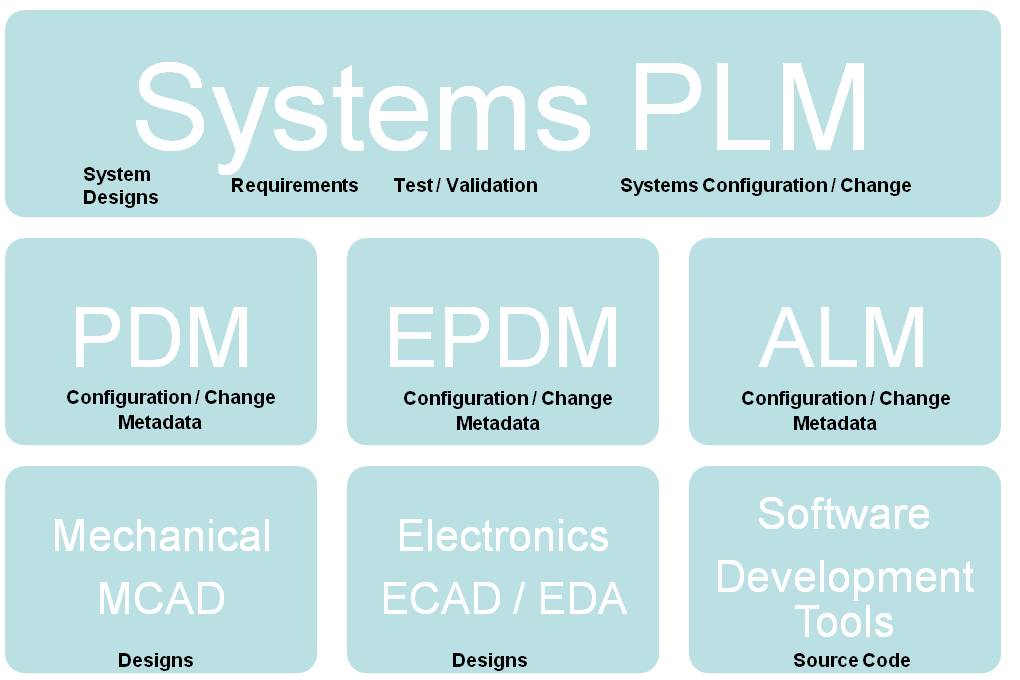
This is the fun part, watching and wondering what comes next. From what I hear from Autodesk a big part of their plan is to watch how customers adopt the solution and use that to help guide direction and strategy. Autodesk realizes they are on a journey and that they (and their customers) have a lot to figure out. That recognition and a willingness to listen to customers gives me some comfort that Autodesk will be a real player in PLM. Time will tell.
So those are my thoughts. Agree? Disagree? Think I am just stating the obvious? Think I am an idiot? Let me know what you think. OK, but if you think I am an idiot please be gentle with your criticism. 😉 Stay tuned for more, the Autodesk PLM story is just beginning to unfold.
Hi Jim,
Yes I think you’re an idiot, but it has nothing to do with this post. (I think it has to do with being a Philly sports fan.)
What Autodesk has done is very interesting. Getting Vault out through the channel has been a challenge, but based on our market data, they have started to make some progress. Keeping engineering work-in-process separate from business process does help to avoid some of the reasons people give from NOT doing PLM on the cloud (bandwidth, IP security, etc.).
I totally agree with your comments about workflow. If people are lucky they have documented workflows. But, in our experience, if they have them they bear little resemblance to the AS PRACTICED workflows. It gets worse. When they do have them, companies often think they are their source of competitive advantage. While this can be true, more often than not those processes are very similar to those used by others and can use some fine tuning. Do companies need outside help to fix this? Yes, they do. And this is where Autodesk need to expand their partner base to provide that assistance.
One interesting thing about the cloud has been seen by Facebook users. When you have on-premise software, you have some choice on when you upgrade. With the cloud, it can be done TO you. Seemingly minor changes outrage Facebook users (who clearly are easily outraged), so what will happen in the PLM space? Like you said, this is just beginning to unfold.
Stan PrzybylinskiDirector of Research
CIMdata, Inc.
s.przybylinski@cimdata.com
A highly configurable solution is a double-edged sword – while it can eliminate some of the potential disruption involved with having the client conforming to the tool and not the other way around – you can still wind up with large implementation costs because it takes a while to figure out how client really runs their business.
You can’t put a price tag on the disruption, but you can on an implementation project that turns into “Apocalypse Now”. How do you manage the risk? How do you justify the expense?
Likewise, if the cloud is supposed to lower the price of technology making it now within reach of the smaller and smaller organizations, isn’t that also offset by the fact that a given functional customization needed for a company of 100 costs the same as it would for 10000 users.
You can’t amortize all that cost in a smaller organization – ever.
It’s the first copy of a software product that bears all of its development costs – all ones after that are free, right?
In my experience, the cost/success of a PLM implementation has more to do with who you have on your team – no so much the product being implemented. Until we can deliver these projects predictably and profitably the rest is noise.
It’s the darned people involved that make this stuff challenging. Software is predicable and repeatable. Implementation, not so much.
Chris,
Thanks for sharing your thoughts, you did a great job articulating the pros and cons of configurability. Tools are easy to implement – but they aren’t very configurable and may not provide the the needed capabilities in a way that leads to the right value. Applications (at least enterprise applications) are much more configurable – leading to (potentially) longer implementations.
I have been struggling with people describing enterprise “apps” like iPhone “apps.” I am probably due for a larger post about this, but iPhone apps only have to work with iOS, the operating system. They don’t have to work together, share data, and support a common business context. That is not true for enterprise applications. Quality applications should link to service should link to configuration management should link to … (you get the picture). In short, the “apps” have to work together and not just fail to crash the OS. To me, the idea of “apps” for an integrated, complex set of data and processes like PLM is new territory. OK, clearly I need to blog about this. 😉
Thanks again Chris, and thanks for bringing the people aspect into it as well. Excellent point.
Best,
Jim
Hi Jim,
Yes I think you’re an idiot, but it has nothing to do with this post. (I think it has to do with being a Philly sports fan.)
What Autodesk has done is very interesting. Getting Vault out through the channel has been a challenge, but based on our market data, they have started to make some progress. Keeping engineering work-in-process separate from business process does help to avoid some of the reasons people give from NOT doing PLM on the cloud (bandwidth, IP security, etc.).
I totally agree with your comments about workflow. If people are lucky they have documented workflows. But, in our experience, if they have them they bear little resemblance to the AS PRACTICED workflows. It gets worse. When they do have them, companies often think they are their source of competitive advantage. While this can be true, more often than not those processes are very similar to those used by others and can use some fine tuning. Do companies need outside help to fix this? Yes, they do. And this is where Autodesk need to expand their partner base to provide that assistance.
One interesting thing about the cloud has been seen by Facebook users. When you have on-premise software, you have some choice on when you upgrade. With the cloud, it can be done TO you. Seemingly minor changes outrage Facebook users (who clearly are easily outraged), so what will happen in the PLM space? Like you said, this is just beginning to unfold.
Stan PrzybylinskiDirector of Research
CIMdata, Inc.
s.przybylinski@cimdata.com
Stan,
Thanks for adding your thoughts. Not the best year for Philly sports, although I was enjoying the NBA season a lot more this year than in previous years. Sixers are still undefeated! 😉
The key issue in my mind is that PLM is not a tool, it is an enterprise application. It impacts a lot of business processes and workflows, and as you say companies will need help. Your observation about workflows not matching the real world are unfortunately more common than not.
I did ask Buzz about upgrades and he mentioned something about being able to control your own codeset… not sure exactly what that looks like and whether that changes the dynamics of the offering. There are still a lot of unknowns, but the one thing I think we all agree on is that this will have an important impact on Autodesk, their partners, their customers, and the market. It will be fun to see how it all unfolds, I look forward to following your thoughts.
Best,
Jim
A highly configurable solution is a double-edged sword – while it can eliminate some of the potential disruption involved with having the client conforming to the tool and not the other way around – you can still wind up with large implementation costs because it takes a while to figure out how client really runs their business.
You can’t put a price tag on the disruption, but you can on an implementation project that turns into “Apocalypse Now”. How do you manage the risk? How do you justify the expense?
Likewise, if the cloud is supposed to lower the price of technology making it now within reach of the smaller and smaller organizations, isn’t that also offset by the fact that a given functional customization needed for a company of 100 costs the same as it would for 10000 users.
You can’t amortize all that cost in a smaller organization – ever.
It’s the first copy of a software product that bears all of its development costs – all ones after that are free, right?
In my experience, the cost/success of a PLM implementation has more to do with who you have on your team – no so much the product being implemented. Until we can deliver these projects predictably and profitably the rest is noise.
It’s the darned people involved that make this stuff challenging. Software is predicable and repeatable. Implementation, not so much.
Chris,
Thanks for sharing your thoughts, you did a great job articulating the pros and cons of configurability. Tools are easy to implement – but they aren’t very configurable and may not provide the the needed capabilities in a way that leads to the right value. Applications (at least enterprise applications) are much more configurable – leading to (potentially) longer implementations.
I have been struggling with people describing enterprise “apps” like iPhone “apps.” I am probably due for a larger post about this, but iPhone apps only have to work with iOS, the operating system. They don’t have to work together, share data, and support a common business context. That is not true for enterprise applications. Quality applications should link to service should link to configuration management should link to … (you get the picture). In short, the “apps” have to work together and not just fail to crash the OS. To me, the idea of “apps” for an integrated, complex set of data and processes like PLM is new territory. OK, clearly I need to blog about this. 😉
Thanks again Chris, and thanks for bringing the people aspect into it as well. Excellent point.
Best,
Jim
A highly configurable solution is a double-edged sword – while it can eliminate some of the potential disruption involved with having the client conforming to the tool and not the other way around – you can still wind up with large implementation costs because it takes a while to figure out how client really runs their business.
You can’t put a price tag on the disruption, but you can on an implementation project that turns into “Apocalypse Now”. How do you manage the risk? How do you justify the expense?
Likewise, if the cloud is supposed to lower the price of technology making it now within reach of the smaller and smaller organizations, isn’t that also offset by the fact that a given functional customization needed for a company of 100 costs the same as it would for 10000 users.
You can’t amortize all that cost in a smaller organization – ever.
It’s the first copy of a software product that bears all of its development costs – all ones after that are free, right?
In my experience, the cost/success of a PLM implementation has more to do with who you have on your team – no so much the product being implemented. Until we can deliver these projects predictably and profitably the rest is noise.
It’s the darned people involved that make this stuff challenging. Software is predicable and repeatable. Implementation, not so much.
Interesting approach from Autodesk in combining their current Vault offering with a future cloud solution. The view that “PLM has been too difficult” is too much of a generalisation though – there are some excellent simple but scalable data management solutions out there that manufacturers have been benefiting from for many years. For example this month our customers are celebrating the 10 year anniversary of our SharePoint based Solid Edge Insight solution:
http://www.plm.automation.siemens.com/en_us/products/velocity/solidedge/insights-10.shtml
While Nero is fiddling our customers are reaping the benefits today!
Dave,
Thanks for your post. To be fair, they did have some interesting survey data to back up the challenges in implementing PLM. PLM is not easy. It is certainly valuable, though, and worth the effort. There are definitely easier-to-deploy solutions, but the difficult part is often defining/changing processes. Solutions that offer best practices help a lot, as discussed in The Business Value of Product Data Management – http://www.tech-clarity.com/overviews/pdm.htm. But organizational change is difficult, and nobody should embark on any PLM implementation without their eyes open to the people issues.
What remains to be seen from Autodesk is whether their new solution addresses those challenges better than current offerings on the market (such as the one you mention). You can’t really evaluate the pros/cons of software that is in production as compared to software that is still being developed. Time will tell.
Thanks for commenting and sharing some more information,
Jim
Interesting approach from Autodesk in combining their current Vault offering with a future cloud solution. The view that “PLM has been too difficult” is too much of a generalisation though – there are some excellent simple but scalable data management solutions out there that manufacturers have been benefiting from for many years. For example this month our customers are celebrating the 10 year anniversary of our SharePoint based Solid Edge Insight solution:
http://www.plm.automation.siemens.com/en_us/products/velocity/solidedge/insights-10.shtml
While Nero is fiddling our customers are reaping the benefits today!
Dave,
Thanks for your post. To be fair, they did have some interesting survey data to back up the challenges in implementing PLM. PLM is not easy. It is certainly valuable, though, and worth the effort. There are definitely easier-to-deploy solutions, but the difficult part is often defining/changing processes. Solutions that offer best practices help a lot, as discussed in The Business Value of Product Data Management – http://www.tech-clarity.com/overviews/pdm.htm. But organizational change is difficult, and nobody should embark on any PLM implementation without their eyes open to the people issues.
What remains to be seen from Autodesk is whether their new solution addresses those challenges better than current offerings on the market (such as the one you mention). You can’t really evaluate the pros/cons of software that is in production as compared to software that is still being developed. Time will tell.
Thanks for commenting and sharing some more information,
Jim
I think you may be understating the complexity of some of
the elements and relationships here Jim. Easy to put a picture up – less so to
make it a reality!
On the specific point of mechatronics…. (Bye the bye, the
term is not synonymous with systems as some tend to proffer; interchanging the
terms at will). It does depend where Autodesk want to focus their efforts. It
may be that complex, multi-disciplinary development and manufacturing isn’t
their current port of call; in which case topics such as ALM, EDA etc. will be
less of a requirement. Their (indicated) solutions stack to date suggests more focus
on small to mid-sized discrete mechanical manufacturers rather than to cars,
planes, satellites, high-tech goods etc.
As for womb-to-tomb and the real value of extended
enterprise PLM, I believe that the key is elegant simplicity. I think that
Autodesk has an opportunity to make a difference here. But the world as we know
it is multi-vendor; often to the chagrin of the vendors… This means that if
one truly wants to create a reality of the vision one must have deliverables
that scale the mountains of (often) proprietary interface…that’ll be
interesting to follow. Having said this, this will provide some interesting business
opportunity for SIs, software developers and partners in general.Such a big topic and so much to say…….
Such a big topic and so much to say…….
Such a big topic and so much to say…….
Thanks Allan,
And so much to learn…. I have more questions than answers so far.
Point taken on systems versus mechatronics.
Cheers,
Jim
I think you may be understating the complexity of some of
the elements and relationships here Jim. Easy to put a picture up – less so to
make it a reality!
On the specific point of mechatronics…. (Bye the bye, the
term is not synonymous with systems as some tend to proffer; interchanging the
terms at will). It does depend where Autodesk want to focus their efforts. It
may be that complex, multi-disciplinary development and manufacturing isn’t
their current port of call; in which case topics such as ALM, EDA etc. will be
less of a requirement. Their (indicated) solutions stack to date suggests more focus
on small to mid-sized discrete mechanical manufacturers rather than to cars,
planes, satellites, high-tech goods etc.
As for womb-to-tomb and the real value of extended
enterprise PLM, I believe that the key is elegant simplicity. I think that
Autodesk has an opportunity to make a difference here. But the world as we know
it is multi-vendor; often to the chagrin of the vendors… This means that if
one truly wants to create a reality of the vision one must have deliverables
that scale the mountains of (often) proprietary interface…that’ll be
interesting to follow. Having said this, this will provide some interesting business
opportunity for SIs, software developers and partners in general.Such a big topic and so much to say…….
Such a big topic and so much to say…….
Such a big topic and so much to say…….
Thanks Allan,
And so much to learn…. I have more questions than answers so far.
Point taken on systems versus mechatronics.
Cheers,
Jim
From Andreas Lindenthal on LinkedIn:
Good question, Jim.
So what? Autodesk is considerably late to the PLM game. And the delivery
model they are offering with Nexus is not really new either. Arena
Solutions has been offering a cloud-based/SaaS/on-demand PLM solution
for almost 10 years now, and others offer similar solutions based on
different technologies.
I think the only way Autodesk can make a difference is by offering a
more flexible, open and scalable solution. Companies want and need to be
able to configure a PLM system to enable, optimize and automate their
processes. Nobody wants to change their processes to accommodate or deal
with the limitations of a PLM system. Where would be the competitive
advantage? Easy to implement and use is one thing, but if this means
less functionality and flexibility, I don’t think many companies will
want to bet their future on such a system. They might go for a limited
deployment in a work group or department, but not as an enterprise-wide
application.
Having said that, Salesforce demonstrated that if done well, a
cloud-based solution can disrupt markets. Siebel and other software
companies that offered on-premise CRM solutions did great until
Salesforce came along and offered an easy to implement and use CRM
solution that was also flexible, open and scalable. Customers could
configure the system based on their needs and requirements, and service
providers could add missing functionality.
If Autodesk can do something similar with Nexus, it could become a
disruptive technology and change the PLM landscape forever. If not, it
will be just another pebble in the ocean. We will see…
Andreas,
Thanks for sharing your thoughts. The one aspect I would consider in this is who do you think Autodesk will be selling to? I think it’s important to consider who their target market will be.
I don’t think Autodesk will be taking away market share from the traditional PLM vendors with this solution in the next few years. I see Autodesk creating a new PLM opportunity for their existing customer base, and hopefully extending the reach of PLM to a broader market. In the near future, I think Autodesk will likely have as much growth as they can realistically handle in their ecosystem without going after any business outside of their own back yard.
Over time maybe Autodesk will branch out and go after SolidWorks users and others if the solution has enough of a competitive advantage. But there are plenty of fish in the Autodesk sea already, and PLM continues to grow. As to whether they have solutions to compete in a larger arena (pun intended, re: Arena Solutions) will be interesting, but won’t limit their success in the near term in my opinion.
Thanks,
Jim
From Andreas Lindenthal on LinkedIn:
Good question, Jim.
So what? Autodesk is considerably late to the PLM game. And the delivery
model they are offering with Nexus is not really new either. Arena
Solutions has been offering a cloud-based/SaaS/on-demand PLM solution
for almost 10 years now, and others offer similar solutions based on
different technologies.
I think the only way Autodesk can make a difference is by offering a
more flexible, open and scalable solution. Companies want and need to be
able to configure a PLM system to enable, optimize and automate their
processes. Nobody wants to change their processes to accommodate or deal
with the limitations of a PLM system. Where would be the competitive
advantage? Easy to implement and use is one thing, but if this means
less functionality and flexibility, I don’t think many companies will
want to bet their future on such a system. They might go for a limited
deployment in a work group or department, but not as an enterprise-wide
application.
Having said that, Salesforce demonstrated that if done well, a
cloud-based solution can disrupt markets. Siebel and other software
companies that offered on-premise CRM solutions did great until
Salesforce came along and offered an easy to implement and use CRM
solution that was also flexible, open and scalable. Customers could
configure the system based on their needs and requirements, and service
providers could add missing functionality.
If Autodesk can do something similar with Nexus, it could become a
disruptive technology and change the PLM landscape forever. If not, it
will be just another pebble in the ocean. We will see
Andreas,
Thanks for sharing your thoughts. The one aspect I would consider in this is who do you think Autodesk will be selling to? I think it’s important to consider who their target market will be.
I don’t think Autodesk will be taking away market share from the traditional PLM vendors with this solution in the next few years. I see Autodesk creating a new PLM opportunity for their existing customer base, and hopefully extending the reach of PLM to a broader market. In the near future, I think Autodesk will likely have as much growth as they can realistically handle in their ecosystem without going after any business outside of their own back yard.
Over time maybe Autodesk will branch out and go after SolidWorks users and others if the solution has enough of a competitive advantage. But there are plenty of fish in the Autodesk sea already, and PLM continues to grow. As to whether they have solutions to compete in a larger arena (pun intended, re: Arena Solutions) will be interesting, but won’t limit their success in the near term in my opinion.
Thanks,
Jim